
Updated · GetClinicTurkey Editorial · General planning information, not personal medical advice.
A trial smile is a temporary, tooth-coloured resin copy of your planned veneers, pressed over your own teeth before any of them is drilled, so you can see, feel and test the new smile and change it while that is still free of consequences. Dentists also call it an intraoral mock-up or diagnostic mock-up. It is taken off afterwards. Before you book veneers or a smile makeover in Turkey, ask whether the plan includes one, and make sure it comes before the preparation day.
- What it is: a removable resin preview of the final shape and length of your front teeth, made from a wax-up of the design.
- Why it matters: it is the last reversible step. Once enamel is removed for veneers, it cannot be put back.
- What it cannot show: how much tooth will be removed, whether your gums and bite are healthy, or the exact colour of the finished ceramic.
- What to ask: is an in-mouth mock-up included, when does it happen, can you take photos and ask for changes, and what do you pay if you stop there?
- Price: there is no fixed price we can publish; ask for the trial smile as its own line on an itemised quote.
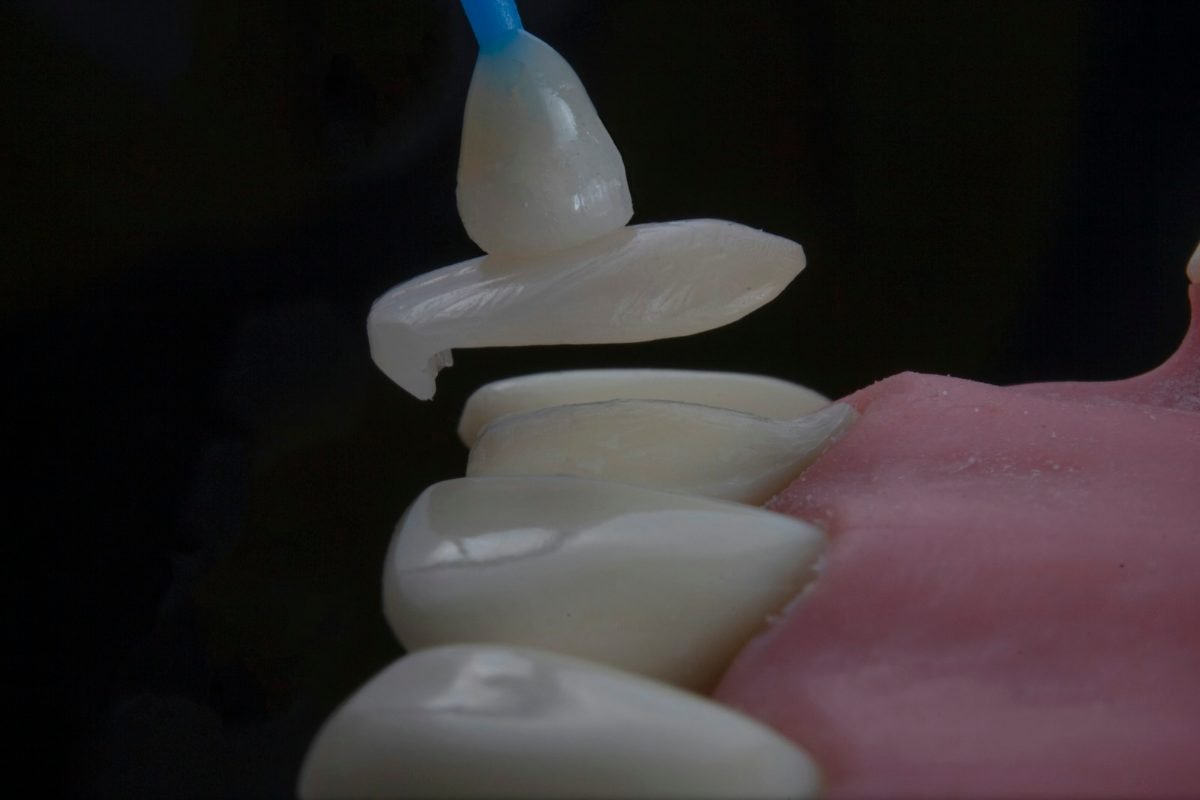
What is a trial smile?
A trial smile starts with a design. The dentist or the lab builds the planned teeth on a model of your mouth, either in wax or digitally (a wax-up). A silicone mould is taken of that design, filled with tooth-coloured resin and seated over your teeth for a few minutes. When the mould is removed, the set resin stays on your teeth and you are wearing a rough copy of the proposed veneers.
Restorative dentists have described this for decades as a planning tool. In a 2004 paper, Magne and Belser describe an “additive diagnostic procedure (ie, wax-up or mock-up)” as the basis for preparing teeth for porcelain veneers, because it allows “more enamel preservation”. The trial smile is the part of that process you can see yourself.
A trial smile is different from a digital smile design shown on a screen, and different from temporaries. The table sets out the three.
| Digital smile preview | Trial smile (in-mouth mock-up) | Temporaries | |
|---|---|---|---|
| When | Before travel or on day one | At the clinic, before any preparation | After preparation, while final veneers are made |
| Teeth drilled? | No | No | Yes, already prepared |
| What you can judge | Overall idea on a photo or video | Length, shape, lip support, how it looks in a mirror and in daylight, how it feels when you talk | Comfort and appearance of the prepared plan |
| Main limit | A picture, not your mouth | Resin, slightly bulkier than the plan, not the final colour | Changes are possible but tooth is already removed |
A peer-reviewed case report on veneer planning puts the gap plainly: “Many times, the DSD simulation is not enough for the patient to understand and observe the changes that will be performed on the anterior teeth.” That is why the authors added a direct mock-up in the mouth after the digital design.
What a trial smile can tell you
- Length and shape. Whether the front teeth look too long, too square or too uniform for your face.
- Lip support. Whether your upper lip sits differently when the teeth are fuller.
- How it feels. How the new edges feel against your lips and tongue when you talk.
- How it photographs. Take photos and a short video in daylight, from the front and at an angle, and look at them again later rather than deciding in the chair.
- Whether the plan is really what you want. Some people realise they want fewer teeth treated, or something more natural, once they see it on their own face.
What a trial smile cannot tell you
A trial smile is a preview of appearance. It is not a diagnosis and it is not a replica of the finished work.
- It does not show how much tooth will be removed. That depends on the plan for each tooth. Our guide to veneers vs crowns explains why you should not approve treatment from a mock-up alone.
- It does not check your health. Decay, gum disease and bite problems need an examination and X-rays.
- It is not exact. In a 2023 laboratory study, every mock-up came out larger than the wax-up it was copied from, and the authors concluded that the mock-up differs from the wax-up “regardless of the technique/materials used”. A 2025 study also found mock-ups thicker than the virtual design. Expect the final veneers to differ slightly.
- It is not the final colour. Temporary resin does not look like finished ceramic. Agree the shade separately.
- It works best where teeth are built up. Because it sits on top of your teeth, it shows added length and volume more easily than a change that needs a tooth to look smaller. Ask how the dentist will deal with any tooth that sits forward of the others.
Use the preview alongside a clinical explanation of the plan. Our veneer-count checklist helps you ask why each tooth is included, while the guide to gum assessment and treatment before veneers covers questions a visual mock-up cannot answer about gum readiness.
Why it matters for how much tooth is removed
The trial smile is not only for you. Some dentists also use it as a guide for preparation: they prepare the teeth through the mock-up, so they remove only what the planned veneer needs. Galip Gürel and colleagues call this the aesthetic pre-evaluative temporary (APT) technique. In their 12-year series of 580 veneers in 66 patients, over 80% of preparations stayed within the enamel, the outer layer of the tooth.
That matters for how long veneers last. In a follow-up analysis of the same 580 veneers, veneers bonded to dentin were about 10 times more likely to fail than those bonded to enamel. Survival was 99% where preparation stayed in enamel and 94% where only the margins were in enamel. These are results from one clinical team, not a promise for your case, but they explain why it is worth asking how your preparation will be guided. For more on lifespan, see how long veneers last.
Where a trial smile fits in a Turkey veneer trip
- Before you travel: send photos and a recent X-ray (see what to send for a dental quote). The clinic may share a digital design. Treat it as an idea, not a plan.
- First clinic visit: examination, X-rays, discussion of options, then the trial smile. Ask for changes if needed.
- Time to decide: ask for the trial smile and the preparation to be on different days, or at least to have a real break between them. Look at your photos away from the chair.
- Preparation: only after you have agreed the design, the number of teeth and the type of restoration for each tooth, in writing.
- Temporaries, then final veneers: ask whether the temporaries will copy the approved design, so you can live with it before the final fit.
If you are comparing a full makeover, our Hollywood Smile guide describes the typical day-by-day process. If you only want one or two teeth changed, composite bonding may be worth discussing instead.
What to ask a clinic before you book
| Question | Why it matters |
|---|---|
| Is an in-mouth trial smile included, or only a digital preview? | A screen preview is not the same as seeing and feeling the design on your own teeth. |
| Is it priced separately? | Some quotes include it and others do not. Ask for it as its own line on an itemised quote. |
| On which day, and how long before preparation? | You need time to decide, which is hard on a tight travel schedule. |
| Can I take photos and video, and ask for changes? | You may see things later that you did not notice in the chair. |
| Will the preparation be guided by the approved mock-up? | A guided preparation aims to remove only what the design needs. |
| Who designs it: the treating dentist or the lab? | You should know who is responsible for the design you approve. |
| What do I pay if I stop after the trial smile? | You can still decide not to go ahead. Know the cost of that before you travel. |
On price: we do not publish a figure for trial smiles. For the veneers themselves, our planning range is €200–350 per tooth for E-max and €80–150 for composite, with worked totals on our veneers in Turkey page. For the wider list of checks, see the 12 questions to ask before a deposit.
What the rules say about information and consent
Turkey’s Patient Rights Regulation (Hasta Hakları Yönetmeliği) says patients must be told about other diagnostic and treatment options and their benefits and risks (Article 15). It gives patients the right to refuse or stop treatment, with the consequences explained (Article 25). Where a written consent form is required, it is signed in two copies and one is given to the patient (Article 26). Ask for your copy.
For UK patients, the General Dental Council’s Standards for the Dental Team are a useful benchmark, although they apply to UK-registered professionals rather than to clinics in Turkey. Standard 3.1 says valid consent means “explaining all the relevant options and the possible costs”, and guidance 3.2.1 says patients should get “a reasonable amount of time to consider that information”. A trial smile on a separate day from preparation is a practical way to get that time.
Frequently asked questions
Is a trial smile the same as temporary veneers?
No. A trial smile is tried on before any tooth is prepared and is removed afterwards. Temporary veneers, or temporaries, are fitted after preparation to cover the teeth while the final veneers are made. Some clinics copy the approved trial smile design into the temporaries, so ask whether yours will.
Does a trial smile damage your teeth?
A trial smile is made from tooth-coloured resin pressed over your unprepared teeth and taken off afterwards, so it is a reversible step. The irreversible step is the preparation that may follow. Ask the dentist to explain how much tooth each veneer will need removed before you agree to that.
Can I have a trial smile before I travel to Turkey?
You can usually see a digital design from photos and X-rays before you travel. A physical trial smile is made in your mouth, so it happens at the clinic. Ask for it to be booked before any preparation day, with time in between to decide.
How much does a trial smile cost in Turkey?
We do not publish a price for trial smiles. Some veneer and smile makeover quotes include a mock-up and others charge for it, so ask for it as a separate line on an itemised quote. Our planning range for E-max veneers is €200–350 per tooth and €80–150 for composite veneers.
What if I do not like my trial smile?
Ask for changes and a second try-in before any tooth is prepared. You can also decide not to go ahead. Ask before you travel what you will pay if you stop after the examination and the trial smile.
Sources
- Magne P, Belser UC. Novel porcelain laminate preparation approach driven by a diagnostic mock-up. J Esthet Restor Dent 2004;16(1):7-16
- Gurel G et al. Clinical performance of porcelain laminate veneers: outcomes of the aesthetic pre-evaluative temporary (APT) technique. Int J Periodontics Restorative Dent 2012;32(6):625-35
- Gurel G et al. Influence of enamel preservation on failure rates of porcelain laminate veneers. Int J Periodontics Restorative Dent 2013;33(1):31-9
- Garcia PP et al. Digital smile design and mock-up technique for esthetic treatment planning with porcelain laminate veneers. J Conserv Dent 2018;21(4):455-8
- Moldovani D et al. Accuracy of indirect veneer mock-up in comparison to diagnostic wax-up. Int J Prosthodont 2023;36(4):443-450
- Ntovas P et al. Impact of material and silicone index support using additively manufactured trays on the reproducibility of diagnostic trial restorations (mock-up): a comparative in-vitro study. J Dent 2025;162:106013
- Hasta Hakları Yönetmeliği (Patient Rights Regulation), Articles 15, 25 and 26 (Mevzuat)
- General Dental Council: Standards for the Dental Team, Principle 3 (consent)
Planning veneers? Compare plans on our veneers in Turkey page or browse the clinic directory, and ask every clinic whether a trial smile comes before preparation.